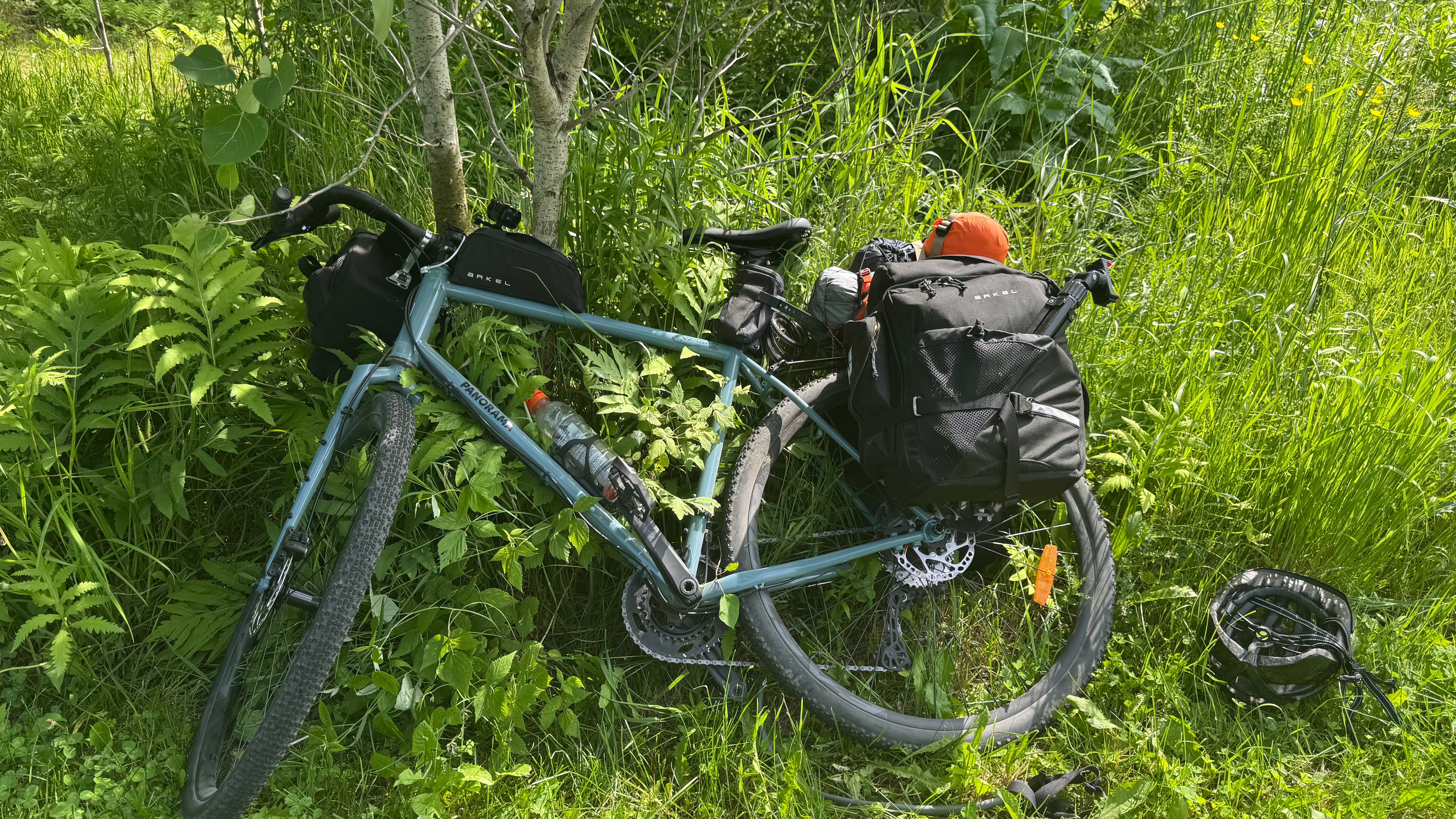


Riding with a purpose: discovering my adoptive country
During the summer of 2025, Jeremy sets off on his Anticosti to discover a Quebec he has called home for 20 years, yet barely knows. Mile after mile, it’s not the physical challenge but the encounters along the way that leave the deepest mark on his journey.
Words & photos : Jeremy Rubier
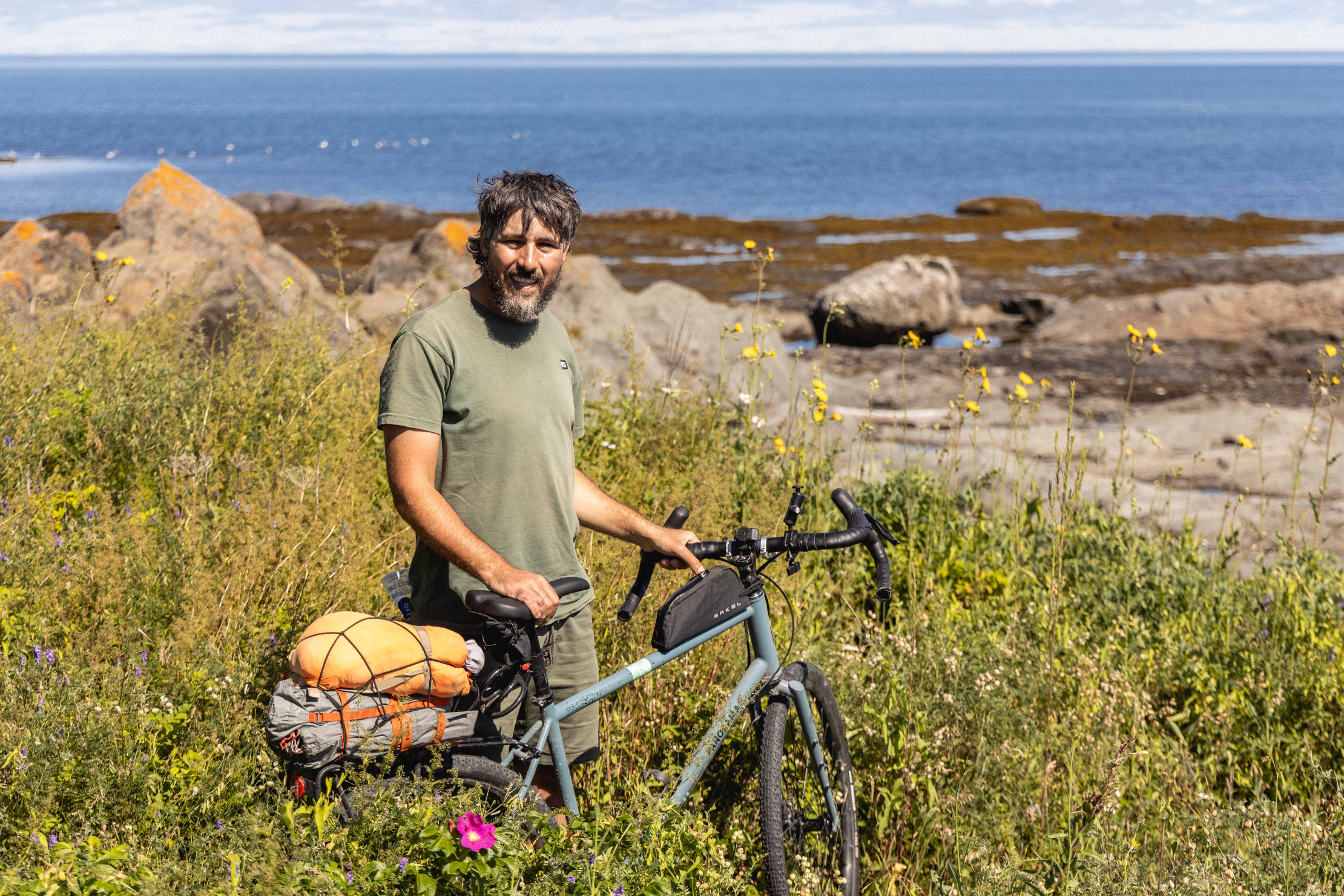

We ride to test ourselves, beyond the usual comfort we're used to. We ride to see if our legs can carry what our heart demands. And because nothing moves at the right speed except a bicycle — not cars, not trains, just us grinding, sweating, laughing into the wind.
I left Montreal June 14th, I was broke, afraid, and my back hurt. I sold my old bike and got a brand new Anticosti. I had a camera strapped like a weapon, and a head full of debts. What the hell was I doing? Riding four thousand clicks across a land I’d called home for twenty years but never touched beyond the city limits.
As a French person arriving in a new country, Montreal had been my cocoon for a while. But I had never really explored beyond the big city, and I couldn’t pretend to know the country without ever crossing the limits of the city. So I set off by bike, with nothing but shaky legs and a promise: to capture the soul of Quebec, and to find out if I truly belonged.


The first days were hellfire. My back cursed, my lungs roasted, the road laughed at me. Then, suddenly, day three, I was flying in an seaplane over the forests of Mauricie with a retired French pilot. Life didn’t make sense anymore. Every door I knocked on swung open. Strangers fed me, gave me water, gave me their stories. Maybe the bicycle was a key. Maybe the pain in my knees was the password.
And then — Québec City. Accidentally, I rolled in on the day of the Saint-Jean, the national day. The streets alive, blue and white flags, songs in the rain. For the first time, I was face to face with real indépendantistes — voices fierce, young, telling me about history, about the dream of a country of their own. It was raw, electric, and I felt the Québec energy more than ever, pulsing in the air, in the crowd, in me.


Charlevoix nearly killed me — hills chewing me up while grief hit like a truck: a friend’s niece dead of cancer. I cried on the climb, called a company for an e-bike, ready to cheat. But then I reached Baie-Saint-Paul, wrecked and somehow stronger. Surprise was my secret weapon: I never researched, never planned. No expectations, no disappointment. Every corner was new. Every smile a miracle.
Saguenay took my breath away. It’s a kind of beauty that doesn’t try to please — raw, proud, almost untamed.
The cliffs fall into the fjord like old scars, and the light settles there like a secret. Everything is bigger than you — the wind, the silence, the stone. You feel that nature never really gave up control here. The fjord pulls you in, humbles you, calms you. It’s a place that both grounds you and overwhelms you.
Visually, it’s unlike anywhere else I’ve seen — a northern light that carves the world like a dream, sharp and peaceful all at once.


Côte-Nord was the biggest culture shock. I lived with the Innu, in a reserve, and it broke my compass. They welcomed me without hesitation, gave me a bed, food, stories. Nobody locks doors there. In the middle of dinner a neighbor just walked in, sat down, no announcement, no excuse — that’s how they live, like family is everyone, like sharing is breathing. It shook me. Made me realize that maybe the whole purpose of my trip was off. Maybe it wasn’t about proving myself strong or cycling far, but about learning how to belong by being let in.
And then — luck, pure luck — the ferry to Gaspésie. Four days without a strike, the only window, and I slipped through like destiny had booked me a ticket. Gaspésie: everyone had warned me about the hills, the brutality, but Charlevoix had already carved me strong. My legs could handle it. The climbs didn’t break me, they just burned, and I welcomed the burn. And the reward: landscapes wild and infinite, cliffs plunging into the sea, villages alive, festive. Gaspésie in summer doesn’t just exist — it celebrates.
Someone told me there are five Gaspésies — five faces, five worlds in one. Crossing it is as long as crossing France north to south, nearly a thousand kilometers. And I felt every one of them: the coast, the cliffs, the hills, the forests, the towns. Each Gaspésie with its own rhythm, its own demand.


By the time I rolled into the Baie-des-Chaleurs, I entered another country entirely: Acadian land. A different culture, softer accents, open tables, and always the story — exile, fire, grief, survival. A sadness that sits deep, but not bitter. More like a scar that becomes part of the face. It made me realize how fractured and yet how whole Quebec is — not one story, but many, stitched together by rivers and roads.
Then Matapédia — the mud, the body sinking, the valley wrapped in mist like a shroud. Still I rode. By then a hundred kilometers in a day wasn’t impossible anymore; it was simply what I did. Sweat pouring, making us riders beautiful in our ugliness. That sweat was our communion.
And then Bas-Saint-Laurent, and it struck like a hymn. I had followed the Saint-Laurent so long it became my bloodstream. And Kamouraska — sunset burning the sky, river blazing like scripture. The Saint-Laurent is the heart of Quebec, and for a while, I lived inside its beat.
By the Cantons de l’Est I was back to something like home. Farms, forests, old friends, laughter. And at last — bike paths, real ones, carved through the woods, soft and quiet. After weeks riding inches from trucks, engines howling at my back, the forest swallowed me, gave me a lane of my own. No mirrors flashing, no tires biting too close. Just the hum of wheels on dirt, birds above, air finally mine to breathe. The Cantons were beauty, yes, but also relief — proof that this road, this province, could make space for fragile human wheels. It felt like coming home.
he only real accident I had on the whole ride happened in Sherbrooke, when my wheel suddenly exploded beneath me. Lucky it wasn’t worse. I stood there on the roadside, clueless — I don’t even know how to change a wheel. But that’s Quebec: before the panic could swallow me, the folks at a little bike shop took me in, laughed, and fixed it on the spot. Their kindness rolled me back onto the road.
That traveling slow is the only way to really arrive. That I could ride 3,000 km and still not know how to fix a damn flat, but I knew how to keep going. This wasn’t just a trip. It was an act of belonging. The camera caught the road, the voices, the broken air, the smoke that chokes our summers. My legs carried me, but the people carried me further.


I arrived back in Montréal exactly two months after my departure, not the same man who had left. The road had carved me, the people had filled me, the rivers and hills had written themselves into my body. I came home changed — stronger, lighter, and finally at peace with calling this place mine.I came back stronger. Three thousand kilometers later, the Anticosti still rolling, my body different, my mind cracked open.
Editing now is harder than the ride — six months of cutting, weaving, music born of the road. I’m raising money to make it real, because the story isn’t finished until it’s told.
Because that’s the only way I know.
Epilogue: I think of the Innus, the Acadiens, the fjord, the sunsets of Kamouraska. I think of the mud in Matapédia, the sweat that made us radiant, hills of the Cantons. Quebec gave me its pulse. I pedaled in time as best I could.
And maybe next year, another land, another river, another ride. Japan, perhaps. Because belonging isn’t a place you arrive — it’s a road you keep riding.