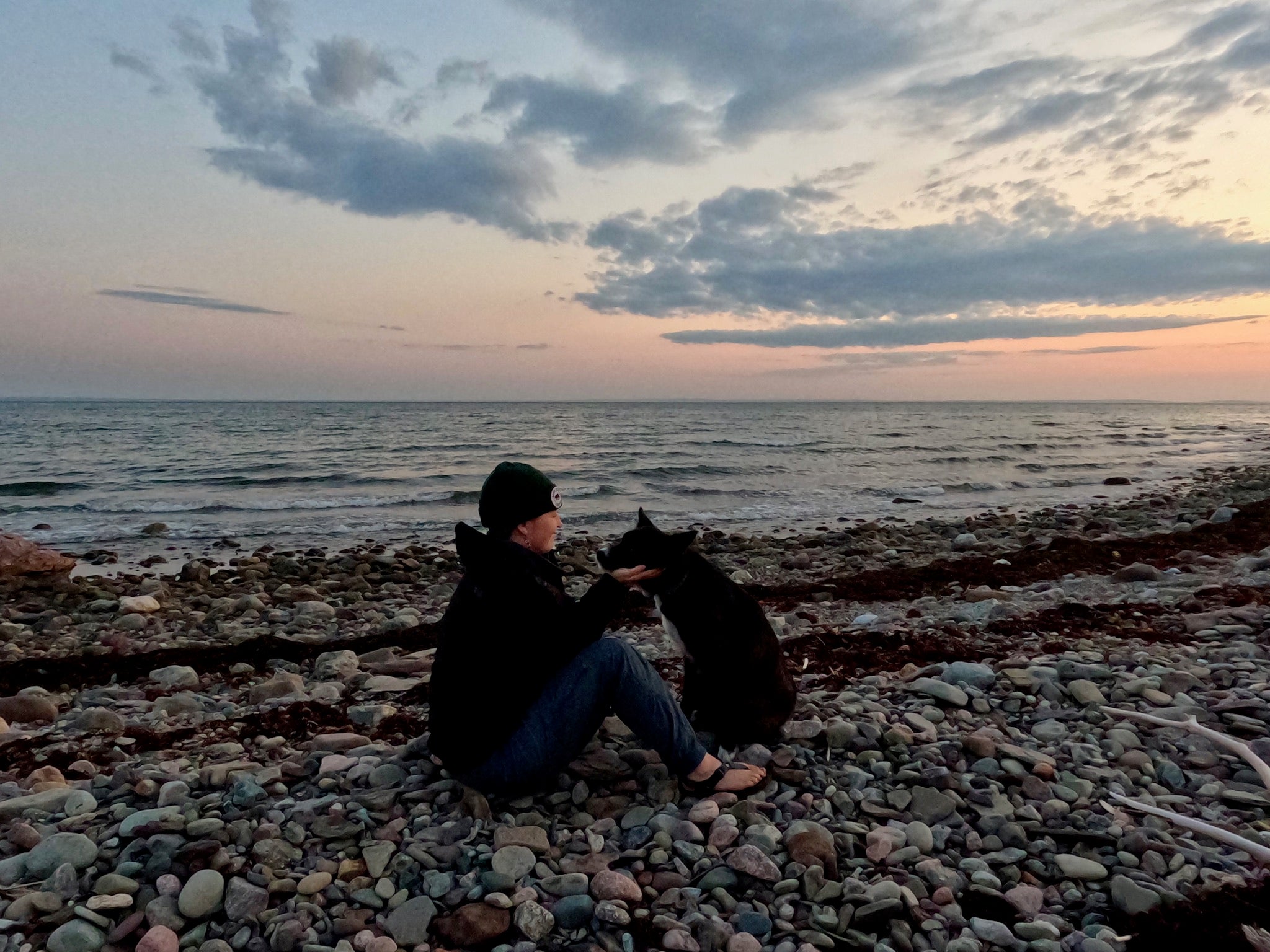


Pedals and Paw Prints: A Season on the Trans-Canada Trail
During the summer of 2024, Bailey Whitnack went on a big adventure with her dog Stoney and her bike on the Trans-Canada Trail. She reflects on a season full of hiccups and lessons, sometimes learned the hard way.
Words & photos : Bailey Whitnack

The Trans Canada Trail stretches more than 30,000 kilometres from coast to coast to coast. It threads together cities, forests, rivers, mountains, and lakes. It isn’t one kind of trail. It’s rail beds and logging roads, ATV tracks and waterways, pavement and wilderness—sometimes all in the same week. More than anything, it’s a connector. Of landscapes, of communities, of ways of moving.
Beginning in the summer of 2024, my dog Stoney and I set out to experience it—all of it. We learned quickly that we would be moving slowly. Very slowly. But thus far we’ve had enough determination to keep moving across our country together, one step, pedal, or paddle at a time.
I didn’t come into this as a novice. Years earlier, I’d thru-hiked Te Araroa in New Zealand and learned the classic long-distance lessons—patience, resilience, and letting fitness build slowly. Still, the Trans Canada Trail humbled me in familiar ways. Different terrain. Bigger logistics. A dog by my side. We were setting out on a trail that refuses to commit to just one mode of travel.


From Foot to Wheels
I began my first season on foot, thru-hiking Newfoundland’s East Coast Trail. It was rugged, wet, steep and spectacular—the kind of terrain where hiking makes sense. Stoney adjusted to carrying her pack while I re-learned lessons I thought I’d already mastered: how to ease into big days, how to listen to my body, how patience isn’t something you learn once and keep forever.
As I neared the end of the ECT, the terrain ahead flattened into long gravel lines of the Newfoundland T’Railway. I could feel it immediately—I was ready to move differently. Ready for momentum. So, I spontaneously bought a $100 second-hand bike and started riding. My first time bike touring, ever.
That bike became my teacher. Seven flat tires. A broken chain link. A failing gear system. It was imperfect, unreliable, and exactly what I needed at the time. It taught me how to adapt, troubleshoot, laugh, and keep going. That scrappy setup carried me through my first season and planted the seed for what I wanted next.


Knowing Better (and Acting Late)
I started my second season more confident—but still walking. I rejoined the trail in Cape Breton, where the Whycocomagh Mountains offered engaging, rugged hiking. But once I left the mountains, the trail widened and flattened. Rail beds. Long road walks. Easy grades that stretched on for days.
I could hike them—but I didn’t love it.
Each day felt slower than it needed to be. Not because I was tired, but because I was bored. I knew better. I knew I enjoyed cycling this kind of terrain more. And still, I found myself walking, wishing I was riding.
That realization stuck. This journey isn’t about doing the trail the “purest” way. It’s about moving in a way that keeps me engaged for the long haul. Hiking rugged sections and cycling long, flat ones isn’t cutting corners—it’s listening.
By the time I reached mainland Nova Scotia, the decision was clear. I needed a bike. Not eventually. Now.


Finding Momentum (the Messy Way)
Getting the Boreal from Panorama Cycles didn’t magically smooth everything out. In fact, it highlighted how unorganized I still was.
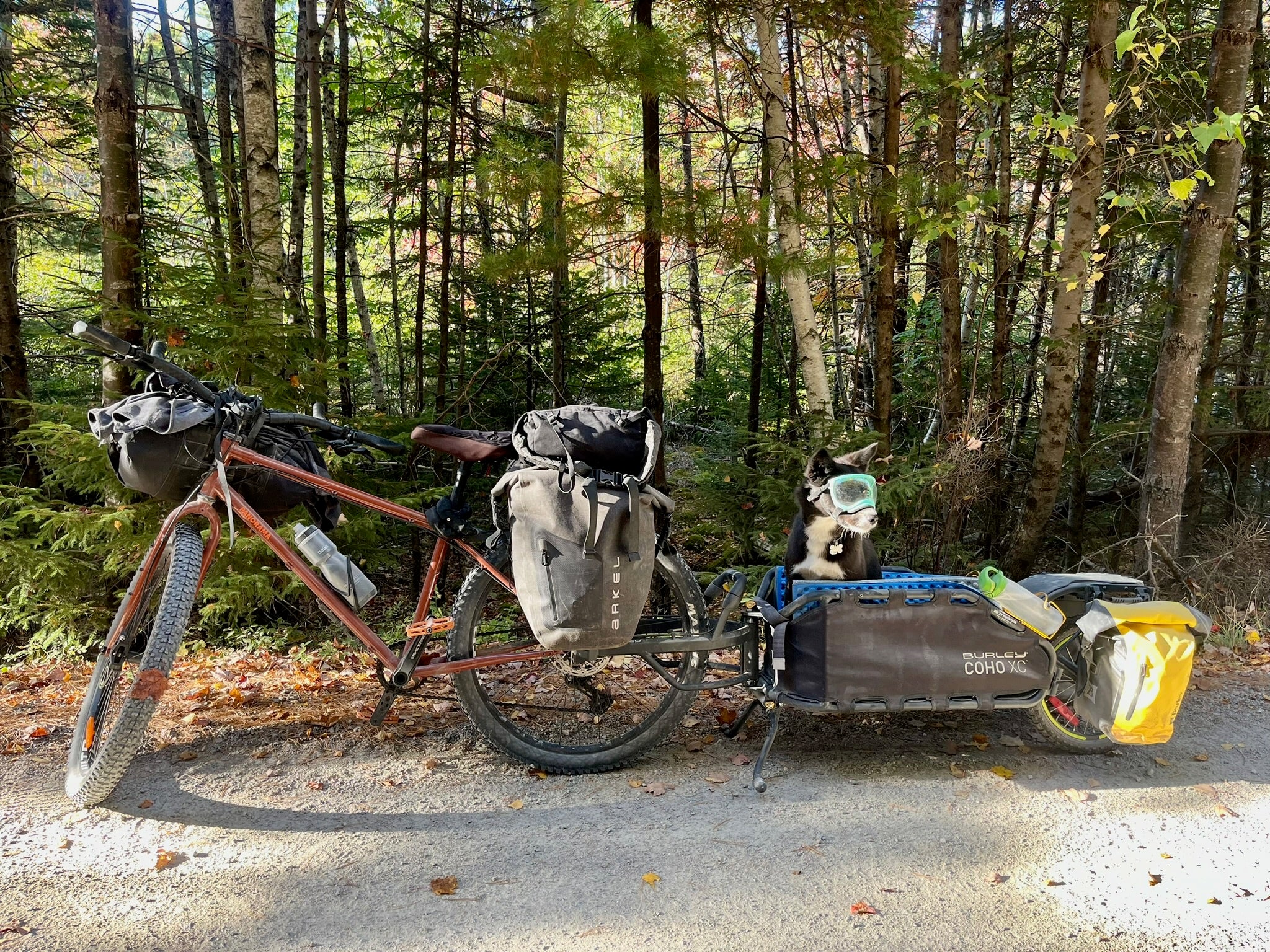
The plan had always been to pull my dog Stoney in a trailer, but I was missing a critical attachment piece. Until it arrived, she had to run beside me. That meant short days and cautious riding as we moved from Truro toward Halifax. It was manageable—but it was the consequence of skipping test rides and assuming things would work themselves out.
I had to wait in Halifax for several days for the missing trailer part. Thankfully, I had the kindest Couchsurfing host, Jay, who let Stoney and I rest up at his place while we waited. When it finally arrived, it felt quietly monumental. I placed Stoney in the trailer, clipped her in and finally, we were off.
We rolled out together along Nova Scotia’s southern shoreline. We rode for one day.
That afternoon, all trails in Nova Scotia were shut down due to extreme wildfire risk. Within hours, our momentum dissolved. The risk of a $25,000 fine made sure we stopped.
With help from generous strangers, I rerouted to Fredericton, New Brunswick. However, trails quickly closed there too. Though roads and waterways remained open. So, we adapted again. With help from friends, I paddled the Saint John River for five days, swimming to cool off in the heat and letting the current and wind dictate the pace. Upon completing that section, I realized that much of the TCT through New Brunswick follows roads anyway, giving us a way forward.


When It Clicked—and When It Didn’t
Hauling the trailer took time to adjust to. Stoney didn’t love it, but we found a rhythm. She ran when she could, rode when she needed to, and kept me honest about pace.
Crossing into Québec felt like an exhale. Le Petit Témis offered lakeside riding, designated campsites, and cycling infrastructure that made sense. My body met the climbs differently now—stronger, steadier. I woke up motivated again.
Then, the trail asked me to slow down once more. The Charlevoix Crossing could only be hiked, and my mum joined me there, bringing a different rhythm and then helping me backtrack to fill in sections I’d skipped during closures.
Momentum, I learned, doesn’t mean consistency. It means adaptability—sometimes flow, sometimes patience, sometimes riding in the “wrong” direction so you can keep going.
The Hardest Day
One of the hardest days came on a section I didn’t realize was primarily a winter snowmobile trail—a detail I’d missed because it wasn’t flagged on my map. I rolled in expecting something rideable and found deep ruts, soft clay, and relentlessly uneven ground.
I pushed the bike for long stretches or crawled forward in the lowest gear. The trailer became a liability—the panniers dragged low and caught on the ruts—so I stripped them off mid-trail just to continue. Progress was painfully slow.
It was late in the season. The days were shorter. Months of adapting and rerouting had caught up with me. Tears were shed. I was scratched up, blood running down my leg, exhausted in the way that isn’t about fitness at all.
I expected to pitch my tent wherever I ran out of daylight. Instead, at the very end of the trail, I stumbled upon a small warm-up hut—completely unmarked on my map. The relief was overwhelming.
What stayed with me wasn’t just how hard that day was, but how well my setup held up. Pushed well outside ideal conditions—loaded, dragged, walked, and ridden through terrain that would test the limits—it never failed. No mechanical surprises. Just something solid beneath the chaos.


What This Season Taught Me
This season didn’t teach me anything radically new. It reminded me of lessons I’d already learned—but needed to relearn.
Patience can’t be rushed. Fitness takes time. Preparation matters, but adaptability matters more. The bike didn’t make things easy—but it made this journey possible in the way I’d been craving since those early walking days.
The Trans Canada Trail doesn’t reward rushing. It rewards attention. Presence. A willingness to change plans and keep moving anyway.
And this season—messy, slow, joyful, challenging—was exactly that.